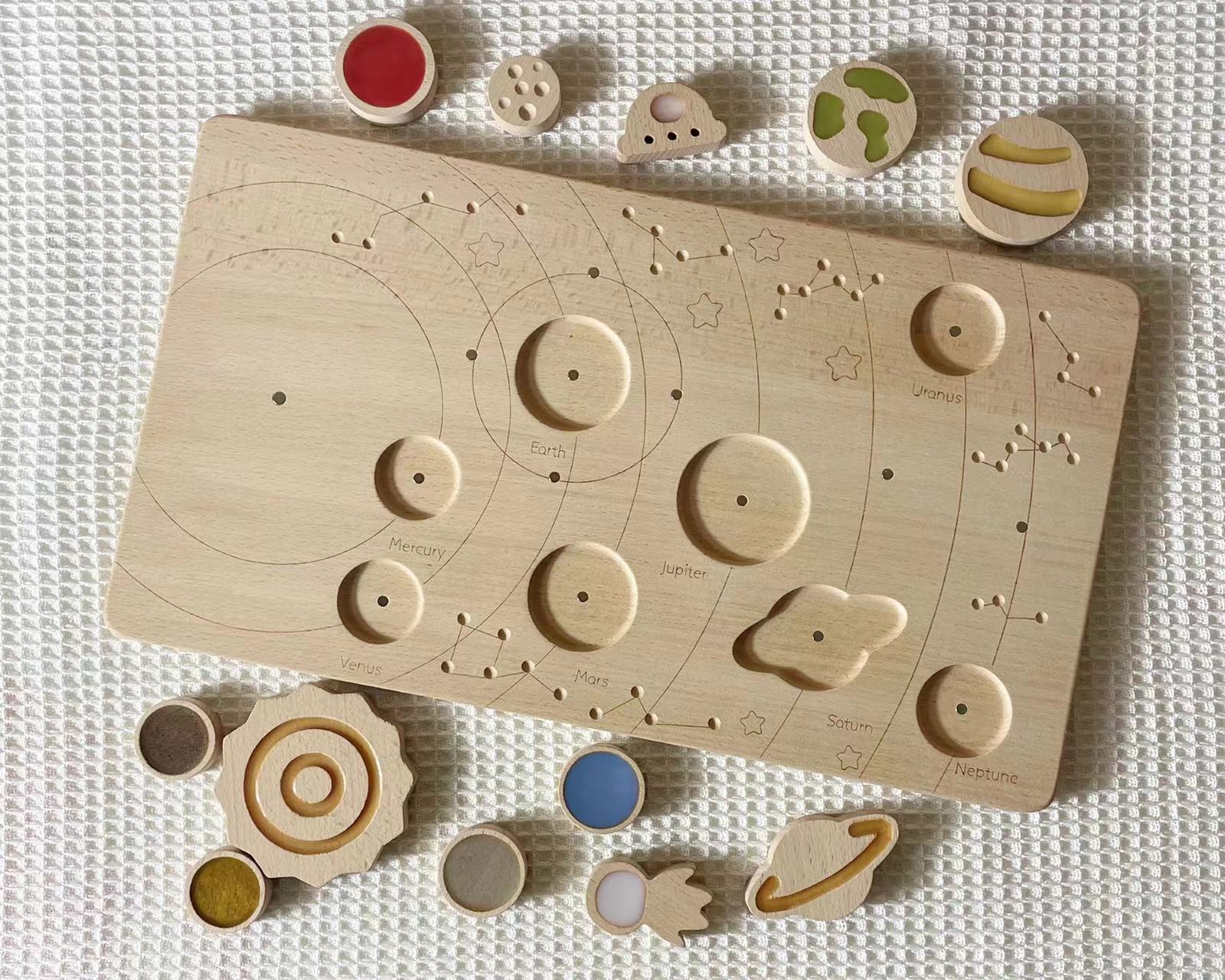
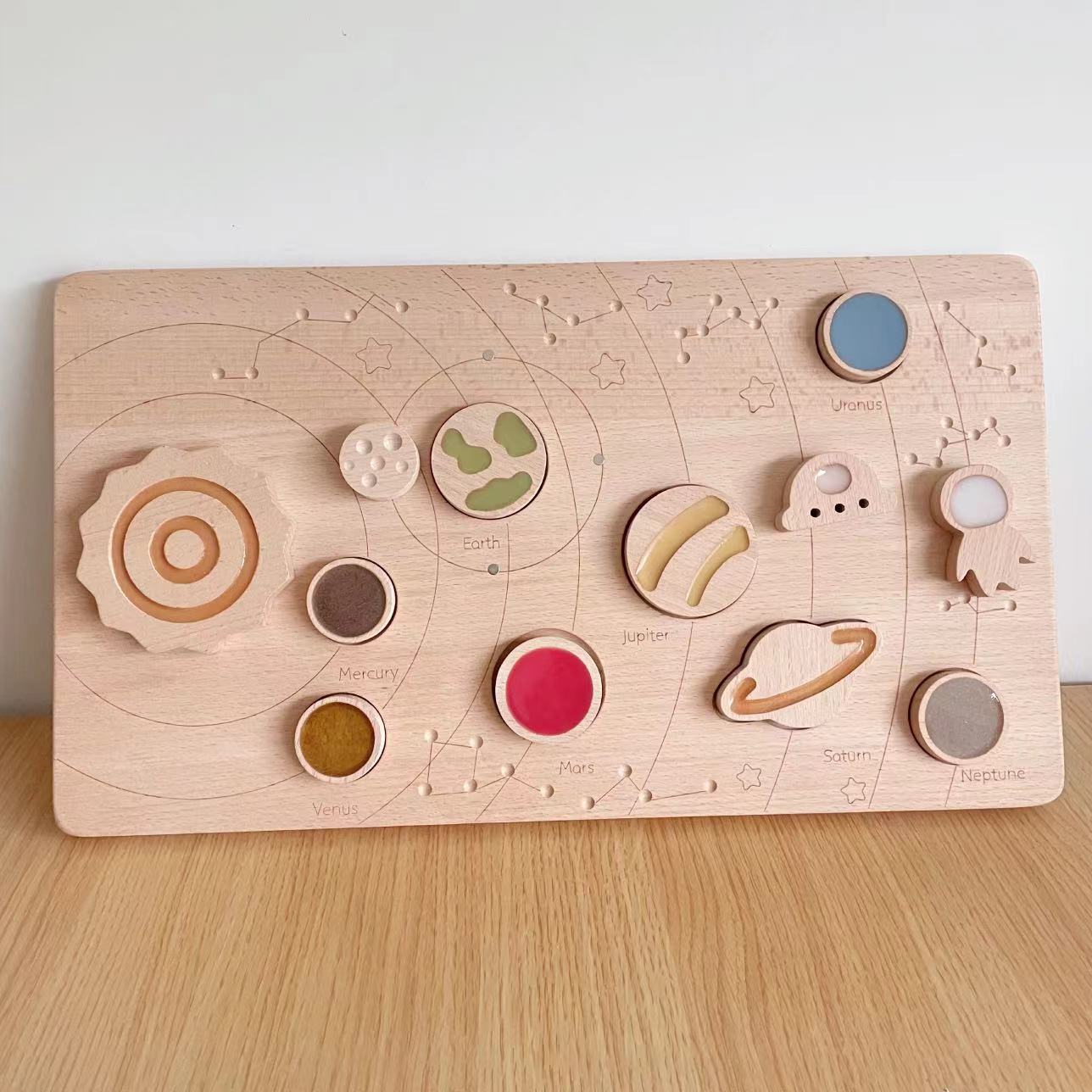
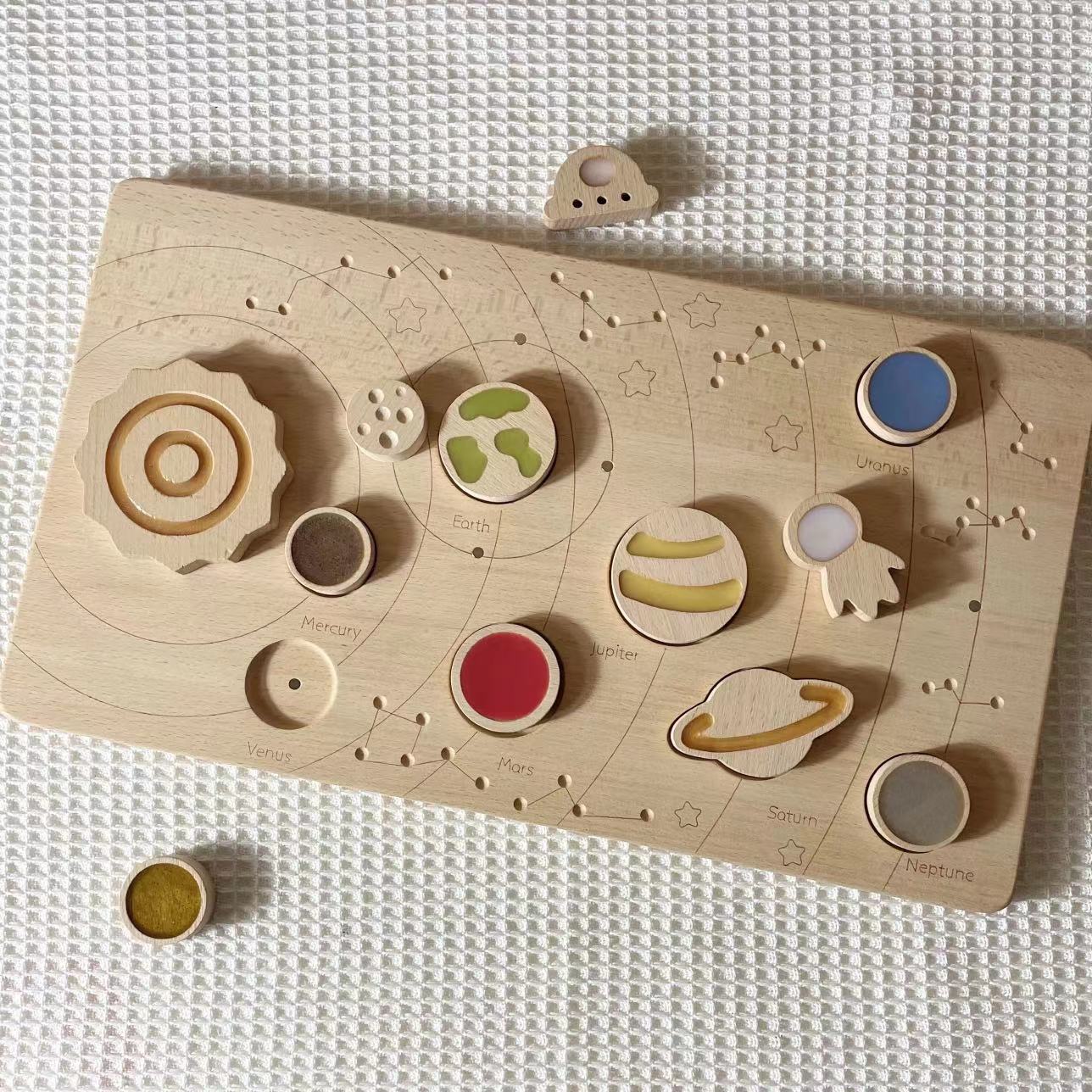
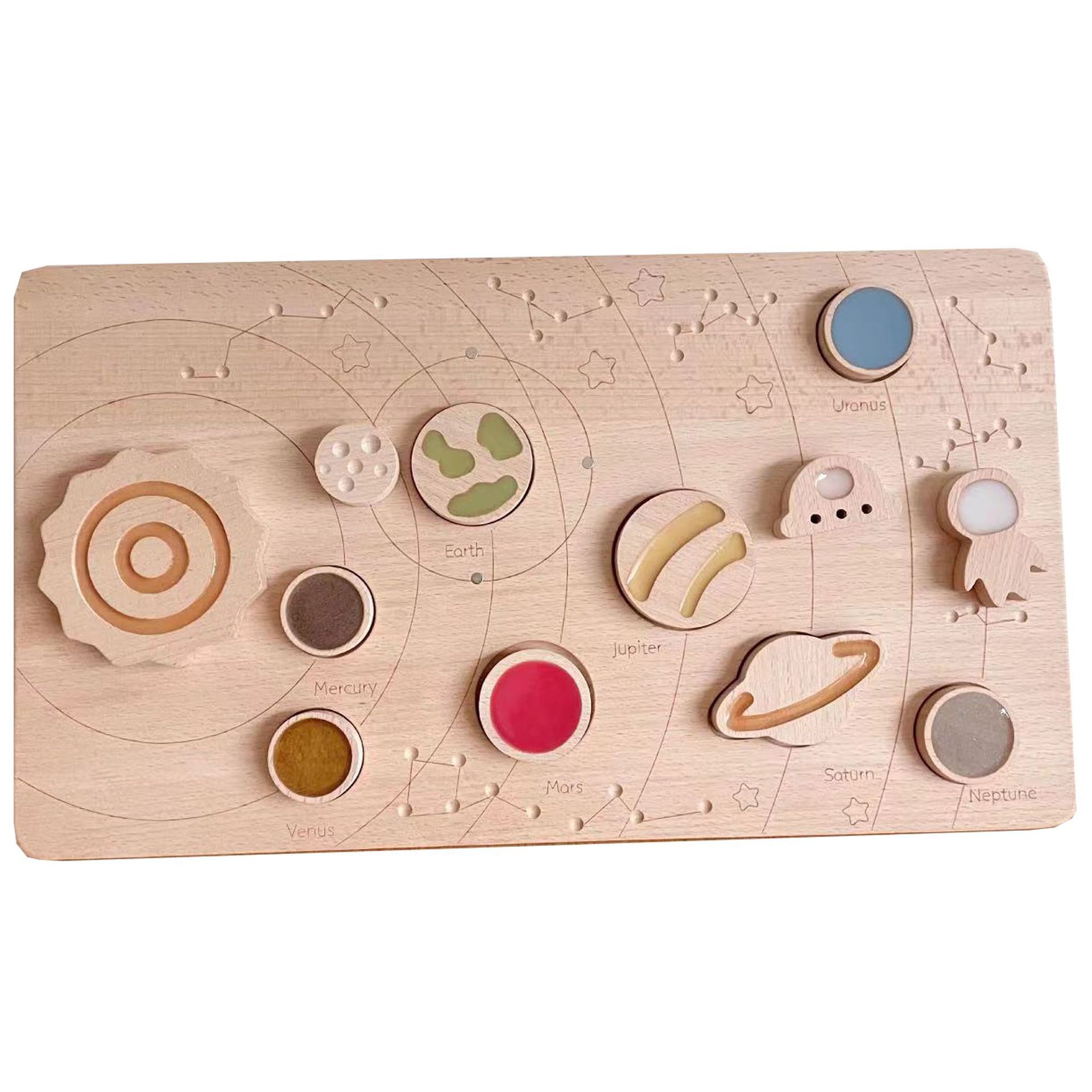
Wooden Magnetic Montessori Solar System Planetary Disk Learning Toy
Couldn't load pickup availability
Description
Product information:
Material: wooden
Category: educational toys
Packing list:
Educational toy X1PCS
Wooden Magnetic Montessori Solar System Planetary Disk Learning Toy
Discover the wonders of space through hands-on learning with the Wooden Magnetic Montessori Solar System Planetary Disk Learning Toy. Designed to introduce children to planets, space, astronomy, positioning, colours, shapes, and early scientific concepts, this beautifully crafted educational toy transforms learning about the solar system into an engaging and interactive experience.
Rather than simply looking at pictures in a book, children can explore the planetary system through touch, movement, placement, matching, observation, and imaginative play. The magnetic planetary pieces encourage children to recognise individual planets, understand their position within the solar system, develop spatial awareness, and build an early curiosity about the universe around them.
Inspired by Montessori-style learning principles, this planetary disk encourages independent discovery, concentration, problem-solving, hand-eye coordination, and active participation. It can be used at home, in classrooms, early learning centres, homeschooling environments, playrooms, and educational activity spaces.
Whether your child is beginning to ask questions about the Moon, Earth, stars, planets, astronauts, or outer space, this wooden planetary learning toy provides an enjoyable way to encourage those interests while developing valuable early learning skills.
Explore the Solar System Through Hands-On Play
Children naturally learn by touching, moving, arranging, repeating, and experimenting. The Wooden Magnetic Montessori Planetary Disk allows young learners to physically interact with a representation of the solar system rather than relying solely on passive learning.
Children can remove planetary elements, identify them, compare their appearance, and place them back into their corresponding positions. This hands-on process helps transform abstract astronomical ideas into something more tangible and understandable.
As children use the planetary disk, parents and educators can introduce simple concepts such as:
-
The names of the planets
-
The position of Earth in the solar system
-
Differences between individual planets
-
The concept of orbiting around the Sun
-
Space and astronomy vocabulary
-
Colours and visual recognition
-
Relative position and sequence
-
Basic scientific observation
-
The difference between Earth and other planets
-
Early discussions about the universe
The level of learning can grow with the child. Younger children can focus on colours, matching, and positioning, while older learners can begin discussing planet names, planetary characteristics, space exploration, and astronomy.
Montessori-Inspired Learning Through Discovery
Montessori-style educational activities encourage children to learn through direct interaction, repetition, independence, and exploration.
The Wooden Magnetic Montessori Planetary Disk supports this learning approach by allowing children to manipulate the pieces themselves. Instead of being told exactly what to do at every stage, children can explore the board, identify visual patterns, test placement, and gradually become familiar with the planetary layout.
This type of independent learning can help children strengthen concentration and confidence while encouraging them to investigate unfamiliar subjects.
Parents can initially demonstrate how the planetary pieces relate to the board and then allow children to repeat the activity independently.
The toy can also become part of structured lessons, storytelling activities, science discussions, matching games, memory challenges, and imaginative space adventures.
Educational Solar System Toy for Curious Young Minds
Space is one of the most fascinating subjects for children. Questions about planets, astronauts, rockets, stars, the Moon, and Earth can inspire a lifelong interest in science.
This educational planetary disk provides an accessible starting point for those conversations.
Instead of introducing astronomy through complex terminology, children can begin with simple visual concepts. They can identify Earth, observe that multiple planets exist, understand that the planets belong to a larger system, and begin developing an awareness of how enormous the universe is.
Parents can build educational activities around the toy by asking questions such as:
“Can you find Earth?”
“Which planet comes next?”
“Can you place the planets in their correct positions?”
“Which planet looks the largest?”
“What colours can you see?”
“Which planet would you like to visit?”
These simple questions encourage communication, memory, reasoning, and imagination.
Magnetic Planet Pieces for Interactive Learning
The magnetic design creates an engaging play experience that encourages children to repeatedly remove and replace the planetary pieces.
Magnetic activities are particularly useful for developing fine motor coordination because children must grasp, position, align, and release each piece carefully.
Repeated placement activities can support:
-
Finger strength
-
Fine motor development
-
Hand-eye coordination
-
Visual tracking
-
Spatial positioning
-
Concentration
-
Matching ability
-
Controlled hand movement
The magnetic interaction can also make the learning activity feel more satisfying and engaging than a traditional flat diagram or printed poster.
Children receive immediate visual feedback when they position the pieces, supporting independent learning and repetition.
Develop Fine Motor Skills
Fine motor development is an important part of early childhood learning.
Children use fine motor skills during everyday activities including writing, drawing, dressing, turning pages, using cutlery, fastening buttons, and handling small objects.
Moving the wooden magnetic planetary pieces requires controlled finger and hand movements. Children practise picking up, rotating, positioning, and placing pieces as they interact with the planetary board.
These movements may appear simple, but repeated manipulation can contribute to improved dexterity and coordination.
Combining educational content with physical activity makes the planetary disk suitable for children who enjoy learning through hands-on experiences.
Improve Hand-Eye Coordination
Children must visually identify where each planetary piece belongs and coordinate their hands to position it correctly.
This process encourages the eyes and hands to work together.
Hand-eye coordination supports many childhood activities, from drawing and handwriting to puzzles, sports, construction toys, and everyday tasks.
The planetary disk provides an enjoyable opportunity to practise these skills while simultaneously learning about space.
Encourage Problem-Solving Skills
When children remove multiple planetary pieces and attempt to place them back correctly, they are naturally engaging in a problem-solving activity.
They may compare colours, sizes, positions, or visual details before deciding where a particular piece belongs.
If the first placement is incorrect, they can reassess the board and try again.
This cycle of observation, experimentation, correction, and success is an important part of independent learning.
Problem-solving activities can encourage patience and persistence while helping children become more comfortable working through challenges.
Support Memory and Recognition
Repeated interaction with the planetary disk can help children become familiar with the appearance and position of different planets.
Parents or educators can gradually introduce planet names and encourage children to match names with visual representations.
Memory activities can include:
-
Naming planets
-
Identifying Earth
-
Removing pieces and asking children to return them
-
Asking which planet comes before or after another
-
Describing a planet and asking the child to identify it
-
Covering part of the board and asking what is missing
-
Recreating the planetary sequence from memory
These activities turn the toy into a flexible learning resource rather than a single-purpose activity.
Introduce Early STEM Learning
STEM education includes science, technology, engineering, and mathematics.
Introducing children to STEM concepts at an early age does not require complicated formulas or advanced lessons. It can begin simply by encouraging curiosity, observation, comparison, questioning, experimentation, and discovery.
The Wooden Magnetic Montessori Planetary Disk introduces early scientific concepts through a subject children often find naturally interesting.
Learning that Earth is one planet within a solar system can inspire questions about astronomy, physics, geography, space travel, gravity, rockets, and the wider universe.
Parents can use the toy as a starting point before introducing books, documentaries, educational videos, astronomy activities, or visits to museums and planetariums.
Learn Planet Names and Solar System Order
Understanding that planets exist in an organised system can help children develop early sequencing skills.
Depending on the specific design of the planetary disk, children can learn to identify and discuss planets such as:
-
Mercury
-
Venus
-
Earth
-
Mars
-
Jupiter
-
Saturn
-
Uranus
-
Neptune
Adults can explain that these planets travel around the Sun and that Earth is the planet where we live.
Older children may enjoy learning additional facts, such as which planets are larger, which planets have rings, which planets are closest to the Sun, and how long planetary orbits take.
The toy therefore provides a foundation for expanding scientific knowledge over time.
Encourage Language and Vocabulary Development
Educational toys can also support communication skills.
When adults discuss the planetary disk with children, they naturally introduce new vocabulary associated with astronomy and science.
Potential vocabulary includes:
planet, Earth, Sun, Moon, orbit, space, solar system, astronaut, universe, telescope, galaxy, rocket, star, astronomy, gravity, exploration, science, distance, rotation, and atmosphere.
Children may begin using these words during imaginative play or conversations.
Asking open-ended questions can further encourage language development.
For example:
“What do you think it would be like to travel to another planet?”
“What would you take with you into space?”
“Why do you think planets look different?”
“What can you tell me about Earth?”
There does not always need to be one correct answer. The goal can simply be to encourage children to think, describe, imagine, and communicate.
Inspires Imaginative Space Adventures
Educational play and imaginative play can work together.
After learning the basic positions of the planets, children can invent their own stories about astronauts, rockets, space missions, scientific discoveries, and journeys through the solar system.
They might pretend to launch from Earth, visit another planet, explore the surface, and return home.
This type of creative storytelling can support imagination, language development, social play, and emotional expression.
Pair the planetary disk with toy rockets, astronaut figures, books, drawing activities, or craft projects to create a complete space-themed learning experience.
Wooden Educational Design
Wooden educational toys remain popular because they offer a tactile, traditional feel that fits naturally into Montessori-inspired playrooms, nurseries, classrooms, and learning spaces.
The wooden construction gives the planetary activity board a distinctive educational appearance and makes it suitable for repeated learning sessions.
The design can also complement other wooden learning resources such as alphabet boards, number puzzles, shape sorters, animal puzzles, stacking toys, geography boards, and Montessori activity sets.
Suitable for Home Learning
Parents looking to introduce structured educational activities at home can incorporate the planetary disk into short learning sessions.
For younger children, a session might simply involve identifying colours and placing pieces.
As the child becomes familiar with the toy, parents can introduce planet names and basic astronomy concepts.
More advanced activities might include:
-
Researching one planet each day
-
Drawing planets after observing the board
-
Creating a solar system poster
-
Comparing planet sizes
-
Learning about astronauts
-
Watching educational space videos
-
Reading astronomy books
-
Learning about space missions
-
Discussing the Moon
-
Building a cardboard rocket
-
Creating a space-themed story
A single educational toy can therefore become the centre of multiple learning activities.
Excellent Addition to Classrooms and Early Learning Spaces
Teachers and early childhood educators can use the planetary disk during science activities, space-themed learning units, group discussions, quiet play, learning stations, or independent activity time.
Children can work individually or cooperate with classmates.
Group activities may involve one child selecting a planet while another identifies it or explains where it belongs.
Teachers can also combine the board with books, flashcards, posters, crafts, experiments, or classroom discussions.
Because children can physically manipulate the pieces, the activity may be especially engaging for learners who prefer hands-on educational experiences.
Great for Homeschooling Activities
Homeschooling families can use the Wooden Magnetic Montessori Planetary Disk as part of an early science or astronomy curriculum.
The toy can serve as an introductory visual aid before moving into more detailed lessons.
Possible homeschool activities include researching individual planets, writing planet names, creating worksheets, comparing distances, studying the Sun, learning about gravity, or exploring the history of space travel.
Children can revisit the planetary disk throughout the learning unit to reinforce information.
Screen-Free Educational Entertainment
Many parents are looking for meaningful screen-free activities that can keep children engaged while also supporting learning.
The Wooden Magnetic Montessori Planetary Disk provides a physical activity that does not depend on phones, tablets, televisions, or computers.
Children can interact directly with the materials and explore at their own pace.
Screen-free play may encourage longer periods of focused interaction and gives children an opportunity to practise physical manipulation, observation, and imaginative thinking.
A Thoughtful Educational Gift
The Wooden Magnetic Montessori Planetary Disk makes a distinctive gift for children who are curious about space, science, planets, rockets, or astronomy.
It can be considered for:
-
Birthdays
-
Christmas
-
Educational gifts
-
Preschool gifts
-
Kindergarten gifts
-
Homeschooling resources
-
Classroom rewards
-
Science-themed gifts
-
Space-themed gifts
-
Learning toys
-
Montessori-inspired gifts
Instead of providing entertainment alone, this gift combines play with educational value.
It can also be paired with a children's astronomy book or space-themed activity set to create a larger educational gift package.
Perfect for Space-Loving Children
Some children become fascinated with space from a very young age.
They may frequently talk about astronauts, rockets, the Moon, planets, stars, and galaxies.
For these children, a planetary learning toy can encourage their existing curiosity while helping them develop broader learning skills.
A child's personal interest can be a powerful motivation for learning.
By connecting activities such as matching, vocabulary, sequencing, and fine motor development with a favourite subject like space, learning can feel much more enjoyable.
Skills This Planetary Learning Toy Can Encourage
The Wooden Magnetic Montessori Planetary Disk can support a variety of early learning activities and developmental skills, including:
-
Planet recognition
-
Solar system awareness
-
Early astronomy knowledge
-
Fine motor development
-
Hand-eye coordination
-
Spatial awareness
-
Visual recognition
-
Matching skills
-
Memory development
-
Concentration
-
Problem-solving
-
Independent learning
-
Vocabulary development
-
Communication
-
Sequencing
-
Colour recognition
-
Scientific curiosity
-
Creative thinking
-
Imaginative play
-
Early STEM learning
The exact learning experience will vary depending on the child's age, developmental stage, interests, and how the toy is used.
Easy Learning Activities to Try
Find Earth
Ask the child to identify Earth from the planetary pieces.
Once they find it, explain that Earth is our home planet.
You can then talk about oceans, land, countries, animals, and people.
Planet Matching
Remove the planetary pieces and ask the child to return each piece to its correct position.
Allow them to experiment before offering assistance.
Planet Naming Game
Point to each planet and say its name.
Repeat the activity regularly until the child begins recognising the names independently.
Space Storytelling
Ask the child to choose a planet and imagine travelling there in a rocket.
Encourage them to explain what they might see.
Planet Observation
Ask children to look carefully at the visual differences between planetary pieces.
Discuss colour, size, pattern, and position.
Memory Challenge
After the child becomes familiar with the board, remove several pieces and ask them to identify which planets are missing.
Solar System Sequence
Encourage older children to learn the order of the planets and practise arranging or identifying them in sequence.
Product Features
-
Wooden solar system learning activity
-
Magnetic planetary pieces
-
Montessori-inspired educational design
-
Interactive space learning toy
-
Supports planet recognition
-
Encourages fine motor development
-
Promotes hand-eye coordination
-
Supports spatial awareness
-
Encourages memory and matching skills
-
Introduces early astronomy concepts
-
Encourages STEM curiosity
-
Suitable for independent or guided learning
-
Useful for home education
-
Suitable for classrooms and playrooms
-
Screen-free learning activity
-
Space-themed educational gift idea
Product Specifications
Product Type: Educational planetary learning toy
Theme: Solar system, planets, astronomy and space
Material: Wood with magnetic learning components
Learning Style: Montessori-inspired hands-on learning
Activity Type: Matching, positioning, identification and educational play
Recommended Use: Home learning, classroom activities, preschool activities, homeschooling and supervised play
Skills Supported: Fine motor skills, recognition, matching, hand-eye coordination, spatial awareness, concentration, vocabulary and early science learning
Design: Wooden planetary disk with removable magnetic planet elements
Please note that colours, dimensions, illustrations, component arrangement, packaging, or small design details may vary depending on the production batch.
How to Use
Place the planetary disk on a stable, flat surface.
Allow the child to observe the different planetary pieces before removing them.
Begin by demonstrating one or two pieces and showing how they can be positioned.
Encourage the child to continue independently.
Introduce planet names gradually rather than trying to teach every concept during the first session.
Repeat the activity over several days or weeks.
As the child becomes more confident, introduce new challenges such as identifying planets from memory or discussing simple astronomy facts.
Adult participation can help transform the activity from a matching toy into a broader educational experience.
Learning Through Repetition
Repetition is an important component of early learning.
Children often enjoy repeating the same activity many times, even after adults believe they have already mastered it.
Each repetition can strengthen recognition, confidence, memory, coordination, and familiarity.
The magnetic planetary disk is designed for this type of repeated interaction.
A child may initially focus only on placing the pieces correctly. Later, they may begin recognising colours. Eventually, they may learn planet names, positions, and scientific facts.
The learning experience evolves naturally as knowledge develops.
Combine With Other Space Activities
Create a larger astronomy learning experience by combining the planetary disk with other activities.
Children can:
-
Draw their favourite planet
-
Build a cardboard rocket
-
Create stars from craft materials
-
Watch the Moon at night
-
Learn about astronauts
-
Read space books
-
Visit a science museum
-
Look through a telescope
-
Create a solar system model
-
Learn simple facts about each planet
-
Make planet flashcards
-
Create a space-themed bedroom display
-
Write a story about travelling through space
These activities can help reinforce what children learn from the planetary disk.
Care Instructions
To help maintain the appearance and condition of the wooden learning toy:
-
Keep the toy in a dry environment.
-
Avoid prolonged exposure to water or moisture.
-
Wipe gently with a soft, slightly damp cloth when necessary.
-
Do not soak wooden components.
-
Allow components to dry completely before storage.
-
Store all planetary pieces together when not in use.
-
Avoid exposing the toy to excessive heat or direct sunlight for extended periods.
-
Regularly inspect components before use.
Adult supervision is recommended according to the child's age and individual developmental stage.
Why Parents Choose Montessori-Inspired Educational Toys
Montessori-inspired toys are often selected because they focus on active participation rather than passive entertainment.
Children interact directly with the learning material.
There are usually clear visual relationships between pieces and their positions, allowing children to experiment independently.
A planetary disk fits naturally into this approach because it combines physical manipulation with real-world educational concepts.
Rather than pressing buttons and waiting for an electronic response, children must observe, think, move, position, compare, and correct.
This active learning process can encourage meaningful engagement.
Frequently Asked Questions
What is the Wooden Magnetic Montessori Planetary Disk?
It is a wooden educational activity designed to introduce children to the solar system and planets through hands-on magnetic play.
What can children learn from it?
Children can develop early awareness of planets and the solar system while practising matching, recognition, sequencing, fine motor skills, hand-eye coordination, memory, and spatial awareness.
Is this an electronic toy?
No. It is designed as a screen-free, hands-on educational activity.
Can it be used for homeschooling?
Yes. It can be incorporated into early science, astronomy, space, or STEM learning activities.
Can teachers use it in classrooms?
Yes. It can be used as part of classroom learning stations, science units, space-themed activities, quiet learning time, or educational play.
Does it help teach planet names?
Yes. Adults can use the planetary pieces to introduce and reinforce individual planet names.
Is it only for learning astronomy?
No. Although the solar system is the main theme, the activity can also support fine motor skills, recognition, memory, concentration, language, matching, and problem-solving.
Can children play with it independently?
Children who understand how the activity works may enjoy using it independently, although supervision should always be appropriate for the child's age and developmental level.
Is it suitable as a gift?
Yes. It can make an educational birthday, Christmas, preschool, homeschooling, or space-themed gift.
Can it be combined with other learning resources?
Yes. It works well alongside astronomy books, planet posters, flashcards, space crafts, toy rockets, educational videos, telescopes, and science activities.
Discover, Learn and Explore the Universe
The Wooden Magnetic Montessori Solar System Planetary Disk Learning Toy combines discovery, hands-on play, and early education in one engaging activity.
Children can touch and position the planets, develop coordination, practise matching, build vocabulary, strengthen memory, and begin understanding that Earth forms part of an extraordinary solar system.
For a child who already loves space, the planetary disk can deepen that interest. For a child who is discovering astronomy for the first time, it can provide an accessible and enjoyable introduction.
From simple matching activities to conversations about planets, astronauts, rockets, and the universe, this wooden educational toy can continue providing new learning opportunities as a child's knowledge grows.
Encourage curiosity, independent discovery, and early scientific thinking with a hands-on planetary learning experience designed to make the solar system exciting, memorable, and fun.